I Ching: 3,000-Year-Old Oracle for Life's Biggest Questions
The Book of Changes — humanity's oldest divination system. A timeless guide for navigating transition, uncertainty, and personal growth.
Casting the Coins...
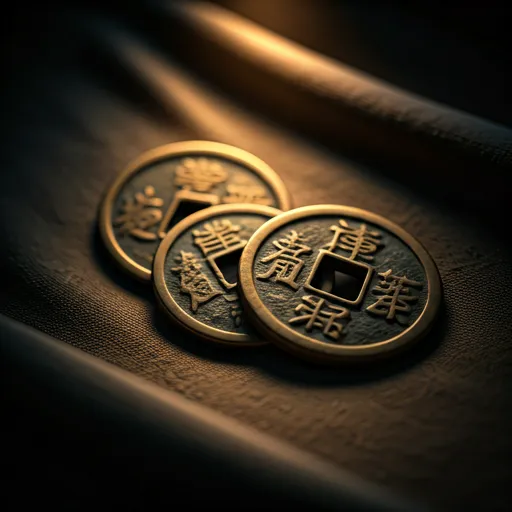
The Book of Changes
The I Ching (易经), or Book of Changes, is one of the world's oldest divination systems. At its heart, it is a map of the cosmic patterns of change that govern the universe and our lives.
"The I Ching is a book of wisdom and divination that has been used for over three thousand years as a guide to the Tao and to oneself."
— Hellmut Wilhelm, The I Ching or Book of ChangesBy observing the interplay of Yin and Yang energies, the I Ching provides a philosophical framework for understanding where we stand in the current stream of time and how to act with wisdom and integrity.
The 64 Hexagrams
touch_app Click any hexagram or watch the oracle cast itself
Key Hexagrams
Waiting for the oracle...
Waiting for the oracle...
Waiting for the oracle...
Experience the Ancient Oracle with AI
Enter your question below. Our AI-guided system will help you cast the virtual coins and provide a deep, contextual interpretation based on the original Zhou Yi text.
Frequently Asked Questions
What is the I Ching?
The I Ching (易经), or Book of Changes, is an ancient Chinese divination text dating back over 3,000 years. It is one of the Five Classics of Confucianism and consists of 64 hexagrams — symbolic figures made of six lines — each representing a unique pattern of change in the cosmos.
How do I cast an I Ching reading?
Traditional methods involve sorting 50 yarrow stalks or tossing three coins six times to build a hexagram from bottom to top. Each toss determines whether a line is solid (Yang) or broken (Yin), and whether it is stable or changing. Online tools simulate this process digitally.
What are hexagrams?
Hexagrams are figures composed of six stacked horizontal lines. Each line is either Yang (solid, unbroken) or Yin (open, broken). With six lines and two possibilities per line, there are exactly 64 unique combinations — each with its own name, image, and judgment text.
How accurate are I Ching readings?
The I Ching does not predict the future in a deterministic sense. It provides philosophical archetypes and patterns that mirror your current situation. The value lies in reflection and the new perspectives it opens — not in fortune-telling accuracy.
Who wrote the I Ching?
Tradition attributes the eight trigrams to the legendary Fuxi, the hexagram system to King Wen of Zhou, and the line judgments to the Duke of Zhou. Confucius is said to have written the Ten Wings commentaries. Modern scholarship dates the core text to the Western Zhou period (1046–771 BCE) with layers added over centuries.
What does "changing lines" mean?
When you cast a hexagram, some lines may be "changing" — meaning they are about to transform into their opposite. These lines carry special advice and produce a second hexagram showing where the situation is heading. The relationship between the two hexagrams reveals the dynamics at play.
What is the concept of the "noble person" (jūnzǐ)?
The jūnzǐ (君子) appears throughout the I Ching as an ideal — a person of ethical integrity who aligns their actions with the natural order. Rather than a fixed status, it represents a lifelong aspiration toward wisdom, sincerity, and right conduct.
What is the difference between Yin and Yang?
Yang represents active, bright, creative energy — associated with heaven, movement, and initiation. Yin represents receptive, still, nurturing energy — associated with earth, rest, and completion. Neither is superior; they are complementary forces that create balance through their interplay.
Can the I Ching help with modern decisions?
Many people use the I Ching as a tool for clarifying complex situations — career changes, relationship dilemmas, creative blocks. The hexagrams frame your question in symbolic language, which can reveal blind spots and patterns you might overlook through linear thinking alone.
How many hexagrams are there?
There are exactly 64 hexagrams, formed from all possible combinations of six Yin or Yang lines. Each has a Chinese name, a traditional image, a judgment, and commentary. The sequence begins with Qián (The Creative) and ends with Wèi Jì (Before Completion).